
Uncategorized
The Dry Powder Query – Ideas From The Chairman #3
I hope you all made the a lot of the quarantined Easter weekend and are holding wholesome.
In my final two notes (right here and right here), I wrote about authorities funding options for startups and scaleups in the course of the Covid-19 disaster. This week I’m going to vary tack a bit to take a look at personal sector funding and the controversy rising round what I’ll name the “dry powder query”.
Fast Replace on Save Our Startups
However first, a check-in on the Save Our Startups marketing campaign, which I wrote about final week. We’ve been thrilled that over 5,000 folks have already signed the petition, and it has gotten widespread media protection. Extra importanty, it seems the Authorities is listening: yesterday’s Telegraph reported that Treasury is on the brink of announce a startup rescue bundle alongside the traces of what the marketing campaign has referred to as for, and I’m listening to comparable indications from my contacts in Whitehall. So hopefully there will probably be excellent news to share shortly.
The Dry Powder Query
One of many explanation why authorities assist for startups and scaleups is so vital, as I mentioned in my final two notes, is that CBILS—the small enterprise lending scheme launched by the Authorities firstly of the disaster—doesn’t work for high-growth loss-making companies. Because it seems, there are some questions round whether or not CBILS is even working for the companies for which it was supposed, however that may be a separate level. The important thing situation is that there’s not but a authorities assist programme appropriate for the nation’s most progressive and high-potential younger corporations.
However we wouldn’t even be speaking about authorities assist if it appeared like personal sector traders may remedy the money downside that so many startups and scaleups will now face. And once I say personal sector traders, what I actually imply is enterprise capital corporations, or VCs. A lot as I consider that traders of all sizes and styles ought to be capable of make investments on this asset class—and because of Seedrs and others, the capital base has diversified considerably during the last decade—by far the vast majority of capital that goes into startups and scaleups nonetheless comes from VCs. So the personal sector’s capacity to plug money shortfalls is primarily a query of what the VCs can, and can, do.
Enter the dry powder query. In broad phrases, dry powder is the quantity that VCs have raised however that has not but been invested. And there’s a lot of it on the market: within the UK and Europe alone, there are billions (or, relying on how broadly one defines VC, tens of billions) of kilos of dry powder that’s theoretically out there to assist startups and scaleups throughout this era. What’s extra, just about each VC basic companion (basic companions, or GPs, are the individuals who handle VC corporations and the funds they elevate) is saying publicly that they’re totally open for enterprise and trying to make investments that dry energy. There are even lists circulating that purport to indicate all of the VCs who’re investing throughout this era.
So downside solved, proper? The money is there to fund these companies, and the VCs say they wish to fund them. Valuations could also be pushed down and phrases like desire buildings might get extra aggressive—which is all simply part of shifting market dynamics—however there isn’t a purpose that corporations ought to wrestle to lift the money they should get via this era. Easy.
Effectively, not fairly. The existence of dry powder on paper and its availability for deployment aren’t all the time the identical factor, and the very best laid plans of GPs can simply go astray. This is because of a mixture of two issues.
One is just bandwidth. VCs are likely to run lean operations even in growth instances, they usually not often have a lot capability to spare in conducting the comparatively labour-intensive endeavor of investing in personal corporations. So now, with enormous quantities of time being taken up supporting portfolio corporations, and plenty of their remaining time being taken up by exterior pressures that this disaster has created (together with issues like offering childcare), many GPs will face an actual operational wrestle in making new investments. Elizabeth Yin, who runs the well-respected San Francisco seed-stage VC Hustle Fund, wrote a superb thread on the nuances round this situation just a few weeks in the past. I anticipate many different VCs discover themselves in an analogous place to Elizabeth.
The opposite, most likely extra important, situation is within the notion of what dry powder actually is. I stated earlier that it’s cash raised by VCs that has not but been deployed, however “raised” is a nuanced phrase. In actuality, most dry powder represents commitments by the fund’s traders (often called its restricted companions, or LPs), that means that the GP nonetheless must name on the money from the LPs, and the LPs nonetheless must pay it over. Therefore we get into conversations just like the one under from LinkedIn (which you’ll see in full right here) between two individuals who know this ecosystem very effectively:
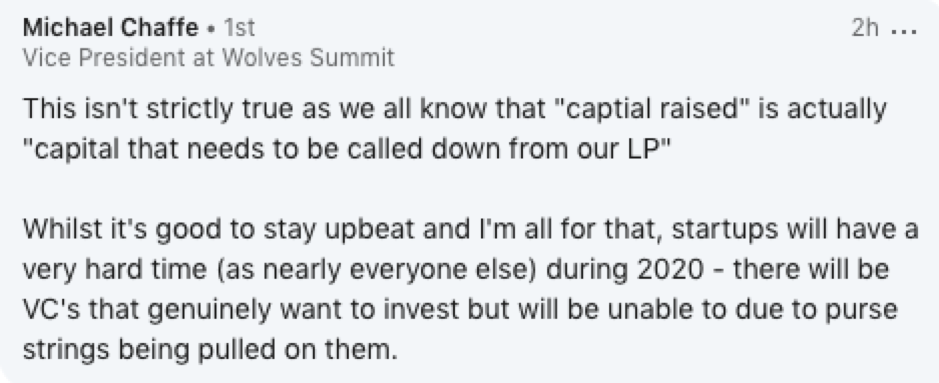
What are the implications of Michael Chaffe’s remark? Is it probably that LPs will merely cease responding to capital calls throughout this era, letting the dry powder go up in smoke? Not precisely: the penalties on an LP for lacking a capital name are extreme—the LP mainly forfeits its entire stake within the fund—so besides within the case of latest funds, the place there isn’t a stake but to lose, I doubt we are going to see quite a lot of LPs merely saying “no” when the GP comes knocking.
However that doesn’t imply LPs are powerless. The mere prospect of a refused capital name will make many GPs nervous. Greater than that, GPs will probably be occupied with their future funds. In the event that they do one thing as we speak that upsets their LPs, then when it comes time to return to these of us for Fund 2 (or Three or 9), they might discover quite a lot of doorways shut of their faces.
And that’s the key to the dry powder query. If LPs don’t need the funds during which they’ve invested to be deploying capital proper now, then they’re able to put quite a lot of stress on the GPs to not deploy capital. Are they really doing so? Sure, though the extent is tough to inform: anecdotally there are tales of LPs exercising their energy come what may throughout this time, however as everyone knows, the plural of “anecdote” will not be “information”.
Extra regarding than the tales is the straightforward actuality of LPs’ positions: most are establishments who make investments throughout a number of asset lessons, and once they make a dedication to a VC fund, they typically make investments the money in a distinct, liquid asset—comparable to listed shares and shares—till it’s referred to as by the VC. With valuations of so many main liquid property having taken a giant hit over the previous two months—however with expectations of a robust rebound after the disaster is over—many LPs will probably be detest to promote their holdings in the mean time. There’ll after all be loads of exceptions, however it’s inevitable that what is going on within the international markets will imply a big variety of LPs will wish to scale back the amount of money they should hand over to GPs proper now.
And that’s what results in a non-public sector funding crunch. The dry powder will not be precisely going up in smoke, however a lot of it will likely be locked away within the journal till this disaster is over.
Assets and Musings
Right here are just a few assets and goings-on I’ve discovered fascinating over the previous couple of weeks:
- From Augmentum Fintech plc, the listed fintech VC (and an investor in Seedrs), comes the good concept of Teen VC, a digital schooling platform for youngsters to find out about VC and entrepreneurship. This could be a nice useful resource for these of you in search of homeschooling concepts in your youngsters, however it additionally has a lot of content material that folks of any age might discover helpful in studying concerning the VC panorama.
- From the Institute of Administrators comes a radical and informative assist hub for companies struggling throughout this time. There are a variety of those kinds of hubs out there, however the IoD’s is among the many finest I’ve seen.
- After which from The Dots, the skilled community for creatives run by the nice Pip Jamieson, comes a set of assets which may be significantly helpful for freelances and independents presently.
Thanks very a lot to Jimmy McLoughlin (whose Navigating the coronavirus for enterprise e-newsletter I discussed just a few weeks in the past) for highlighting the final two of these.
And lastly, just a few tweets I believed value sharing:
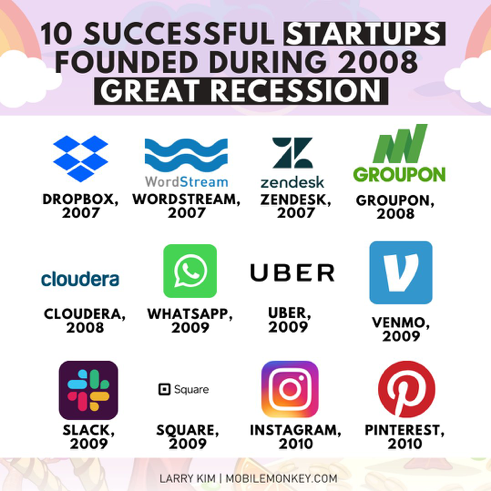
- Larry Kim of Cellular Monkey gives some encouragement by noting just a few of the companies that have been based in the course of the final downturn. He constructed on his authentic tweet with this little graphic:
- Paul Graham, the YC founder and essayist, additionally displays on beginning a enterprise throughout troublesome instances, tweeting: “Buyers: Any startup that will get began in the course of the subsequent few months is disproportionately more likely to succeed. Success relies upon most of all on dedication, and picture how decided it’s a must to be to start out a startup in the course of a world pandemic.” Having begun work on Seedrs over the past disaster—which was not almost as intense as this one, however nonetheless required a heck of quite a lot of dedication—Paul’s view resonates with me.
- A unique form of perspective comes from a contributor to the favored ZeroHedge weblog who tweets: “AirBnB is about to crash the US housing market. 1000’s of super-hosts who purchased 10, 20, 30 properties with mortgages and are closely levered…are all about to default. With out journey there isn’t a rental revenue to pay these mortgages. In 2-Three months – 2008 another time. Growth.” I extremely doubt the information helps the enormity of this assertion, however the concept that a slowdown for Airbnb—a enterprise that was promoting politically-themed cereal on the time of the final housing disaster—could be enough to trigger significant challenges to the U.S. (and doubtlessly international) housing market does present how a tiny firm run by decided entrepreneurs can flip into a big participant within the international financial system.
- Lastly, Simon Hoare, the Conservative MP for North Dorset, tweeted the next in response to the Prime Minister’s broadcast from Chequers after he was discharged from hospital: “I’ve no specific perception on this matter BUT my hunch is that that great, heartfelt tackle by the PM may (ought to) presage a recalibration of immigration policy- one the place value is extra vital than revenue bracket. It’s what being a liberal One Nation Tory is all about.” Whether or not one thinks that’s more likely to occur most likely is determined by one’s politics and views on Boris Johnson, however it’s at the very least an encouraging thought. For many people, the best sensible disappointment of Brexit has been the prospect of dropping the gifted, bold folks from throughout Europe who’ve shaped the spine of the startup and scaleup ecosystem. To some extent that is still unavoidable, however wouldn’t it’s good if the dedication of Kiwi and Portuguese nurses wound up nudging the PM towards favouring a considerably extra open Britain?
***
That’s it from me for this week. As all the time please do let me know any suggestions or contributions, and I hope you all keep effectively and secure within the week forward.

Jeff Lynn
I am Govt Chairman and Co-Founding father of Seedrs.